Christmas carols on guitar for beginners: from two chords
We have ordered the carols in the catalogue from the simplest to the harder ones. We start with those that need only two grips.
Adrian4 minupdated
24 December is our deadline, there is still a little time, and if you are already late, do not worry. The next chance is only a year away 😄. Let’s see whether this year, at the Christmas Eve table, we can sing together with a guitar. That is why we start with the simplest carol, so you can learn it as quickly as possible.
We have set the list below from the easiest carols to the harder ones. That way you will be able to play complete songs sooner. Each carol is in our catalogue and has a guitar strum assigned to it, which you will later use in other songs.
| Carol | Grips | Time | Strum in the app |
|---|---|---|---|
| Two grips | |||
| Wśród nocnej ciszy | C G | 4/4 | March (Universal) |
| Three grips, no barre chords | |||
| Tryumfy Króla Niebieskiego | C G D | 4/4 | Folk |
| Pójdźmy wszyscy do stajenki | C G Am | 4/4 | March (Universal) |
| Three grips, including F | |||
| Cicha Noc (Silent Night) | C G F | 3/4 | Szesnastka 3/4 (songbook) |
| Five grips and more | |||
| Gdy się Chrystus rodzi | Am F Dm C G7 G E | 4/4 | Szesnastka |
| Dzisiaj w Betlejem | C A A7 Dm G Am F | 3/4 | Szesnastka 3/4 (songbook) |
| Lulajże Jezuniu | C Dm G Am F | 3/4 | Szesnastka 3/4 (songbook) |
| Bóg się rodzi | Am D7 G E7 C D | 3/4 | Szesnastka 3/4 (songbook) |
The Polish titles stay, because this course is for a Polish Christmas Eve table. Where the catalogue also has an English counterpart on the same idea, we put it beside the Polish one. I Saw Three Ships sits on two grips, like Wśród nocnej ciszy. Jingle Bells and Silent Night sit with F, like Cicha Noc.
A carol in three, or in four?
The biggest trap for a beginner is playing a strum “in four”, for example the scout strum, when the song is in three (1 and 2 and 3 and 1 and 2 and 3 and). If you are not sure, it is worth checking a few times: try counting it yourself, or look it up in our app.
If you feel that something does not fit the words, that something does not sound right, you may have chosen the wrong strum. Or you are playing unevenly, too fast or too slow, and you “eat” bars, for example every “and” runs away. Then we recommend trying with the Metronome or with a drum backing. Both modes are in our app.
How to avoid the barre chord F?
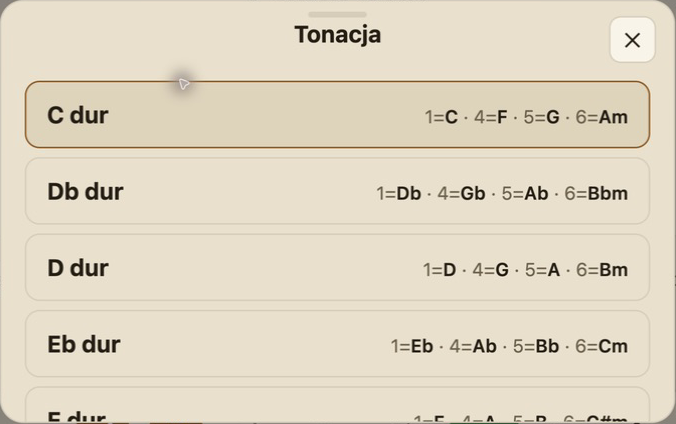
In many carols the barre chord F appears. A capo or a key change can help, so you do not have to play it at once. In our case it is enough to put the capo at the fifth fret and, instead of the grips C, F and G, play G, C and D. You will hear the same chords, and you skip the barre grip F.
You may also meet the opposite: someone plays the grips C, F and G with a capo at the second fret. To play along without a capo, use D, G and A. The C grip with that capo then sounds as D, F as G, and G as A.
If you do not have a capo yet, you can try Fmaj7 instead of F. It sounds a little different, so check whether it fits that place in the carol.
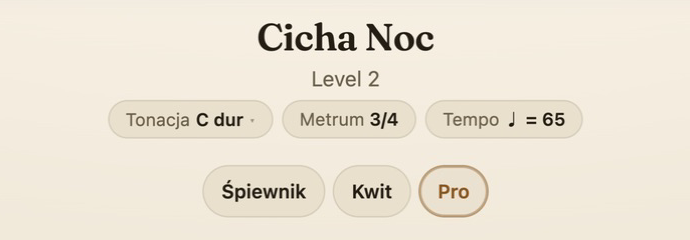
The last way is a key change. Open Cicha Noc in our app and, once you are logged in, choose “Key”. Below we show where to find it:
A well-known carol is not the easiest
A slow, familiar carol can be much harder to play than something brand new that you learn from scratch. Why? Your head is full of habits. You may have sung that song “crooked”, “by feel”, your whole life, so while you learn you are fighting those habits.
On top of that, in slow songs every late or early change is audible. And if everybody knows the carol, they will catch every stumble more easily. So practise the grip changes on their own, even if you can sing the whole text without a sheet. We had that too, and do not worry, it is normal! 😄
We start with Wśród nocnej ciszy
In the next lesson we will try to play it on C and G. You can already open the carol and listen to how it sounds.
Open Wśród nocnej ciszy